Right off the bat, I’m going to contradict the premise of my own title, by stating; there are primitive and instinctive reactions that are innate to our being. Meaning, this form of reactivity is certainly not a symptom of the overactive ego, but rather a response to our environment as a means of survival. As you might of gathered, this will be a compositional analysis of the idea of “reaction.” With that said, you may have had a particular reaction or skepticism towards the opening sentence, as it is contradictory to the title. My explanation is that the title was spontaneous and I am here to explore it, after all; the name of this blog is Infinite Seeking.
As a basic definition, reaction is the action or expression that follows a happening. For example, if a person were to say something that you feel is rude, you may react either verbally or physically (or not at all). In this case, what is said is the “happening” and what follows is the “reaction.” The questions I then pose are, does a happening always necessitate a reaction? Do we often react in a positive or negative manner? Does the reaction serve or harm our well-being? Is the reaction to validate or add to a point made? Is the reaction to get even with the opposer? Is the reaction to be right or prove a point, to be in a position of superiority? If none of the above, then why do we react? Have we simply become accustom to reacting no matter the type of happening, in a habitual and subconscious fashion? All these are questions that I contemplate in order to bring awareness to why I react, to possibly delay an unhelpful and unwarranted response.
Continually, how do we reach the point of reaction? I would say it is through the processing of a happening that we come to interpret how we will move forward. So then, is the processing an automatic or manual function? Is it something that is initiated consciously or subconsciously? In my personal experience, I’ve found that the more emotionally attached I am to something the more likely I am to react automatically and without thought. For example, initially when I dropped out of college, there were certainly moments where I reacted from a place of defensiveness, caused by an attachment to a decision I felt others did not understand, and as a whole; this perspective gave rise to a particular emotional response. With that said, in the book, Thinking Fast and Slow, Daniel Kahneman speaks about two ways in which we think: System 1 and System 2. System 1 would be your automatic thinking-response, where as; System 2 would be a more thorough and processed method of thinking-response. In terms of reaction, it seems our System 1 usually gets the best of us. It is common for a reaction to precede the thought of why we did so. And, typically there is a correlation between the emotional strength and quickness in which we respond. Our rational mind cannot be present when we are emotional and vice versa. But then, how do we know if we are being emotional or rational? I would say, it is by being presently observant that we can bring awareness to why we do what we do.
Now, where does this idea of reactivity being a symptom of the overactive ego come into play? Well to start, I will address the concept of the ego. Simply put, the ego is “you.” It is the identity and personality in which we all know ourselves by; the way we interact and perceive each others is all through this idea of “I” of “me.” Eric Abrons is a humanistic construct and abstraction of the natural world, a conceptual extension of the physical body. These identities serve as a way for our societies to function the way they do; they facilitate the ability for people to “understand” who you are, in a world run by postulated notions and social constructs. I put understand in quotations because to reach a point of complete self- understanding is unattainable, and so to find that in another person is absurd. This is another symptom of the ego, the thought of figuring people or things out. Ultimately, the ego will exercise its power over your mind as a means of control, to keep in place its idea of the surrounding world.
The ego, however, is not who you really are. The ego is your self-image; it is your social mask; it is the role you are playing. Your social mask thrives on approval. It wants control, and is sustained by power, because it lives in fear.
Deepak Chopra
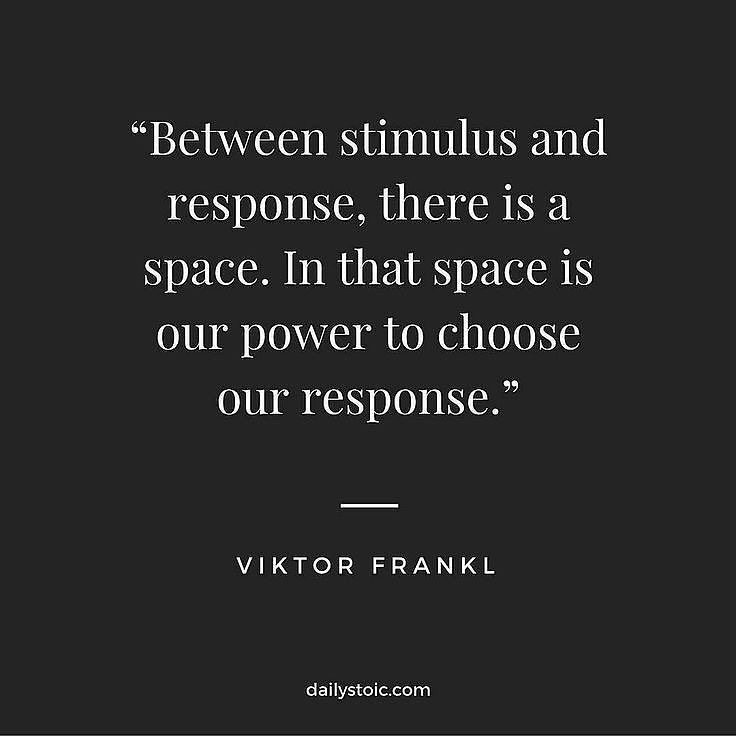
To come full circle, I feel it would be fitting to propose a healthy approach towards this reaction dilemma. As mentioned before, reaction is the result of the ego processing and interpreting a happening. Therefore, if there can be a delay between the happening and processing then the reaction can be avoided by virtue of being observant. This way, the awareness of the situation at hand will lead to a conscious choice, which will inhibit the automatic response. By doing this, you are transcending the grip of the ego and acting in the moment as an authentic human being. Eckhart Tolle expresses that, “non reaction to the ego in others is one of the most effective ways not only of going beyond ego in yourself but also of dissolving the collective human ego.” Ironically, it seems the most effective way to go about reacting is to merely not react, as a service to your own well-being, but also to others who are indirectly effected by your ability to withdraw from the control of the ego. In conclusion, be vigilant of your mind and its thoughts; be observant of your behavioral patterns, and when in doubt; delay the response.


Here are my answers to your questions!
The questions I then pose are, does a happening always necessitate a reaction?
No, though I believe people are conditioned to react when something happens, even if they have no intention or if what happened does not impact them. I think it is just something we have learned to do by nature.
Do we often react in a positive or negative manner?
Most people tend to react negatively. I can ask you how the weather is and you will probably tell me it is too hot, too cold, too wet etc; I think this is again something we have been conditioned to do. I personally strive to react positively whenever possible but often encounter a negative reaction when I do!
Does the reaction serve or harm our well-being?
In my own opinion being conditioned to be negative harms our well-being. It prevents us from taking a step into the unknown, trying new things, expanding our minds, pursuing infinite seeking.
Is the reaction to validate or add to a point made?
Negative reactions do neither but attempt to negate a point that was made. Let’s say I tell you that Eisenhower was a good President. A negative response might be, “He played too much golf.”
If I say that the Nets are a good offensive rebounding team, a negative response might be “because they miss so many easy shots.”
If the response is positive it will reinforce a point but the person has to go further than a simple response in order to add to the point.
Is the reaction to get even with the opposer?
I have seen this recently in my life. A young man old enough to be my son just lost his dad to cancer. He has become very depressed and I suspect suicidal. He has become confrontational at times and at other times very withdrawn. Sometimes it is as if he wants to make a scene. I suspect he is lashing out to let go of anger and that might be what many do.
Is the reaction to be right or prove a point, to be in a position of superiority?
I think most people are conditioned to not only be negative but to be right so I find disarming people with a statement like, “I politely disagree” or “You prove a valid point, though….”
If none of the above, then why do we react?
Perhaps this ties into ego or as you put it, our false self. We react to prove we are right, to feel better, even if doesn’t concern us. We just need our egos cuddled with inner-satisfaction. Perhaps that is part of our emotional attachment, that we are attached with feeling superior and never being wrong.
Have we simply become accustom to reacting no matter the type of happening, in a habitual and subconscious fashion?
I think we are conditioned to react. People ask what we think about things all the time and we are told that “not caring” is a negative response so we respond with something because we are expected to.
LikeLike